 Add to Chrome
 Add to Firefox
 Add to Edge
CoMem: Context Management with A Decoupled Long-Context Model
May 29, 2026
Context management enables agentic models to solve long-horizon tasks through iterative summarization of previous interaction histories. However, this process typically incurs substantial decoding overhead for the extra summarization tokens, which significantly affect the end-to-end response latency at deployment. In this paper, we introduce CoMem, a novel framework that decouples memory management from the primary agent workflow, enabling these processes to execute in parallel. We propose a $k$-step-off asynchronous pipeline that overlaps the memory model's summarization with the agent's inference, effectively masking the latency of context processing. To ensure robustness under this asynchronous setting, we introduce a reward-driven training strategy that aligns the memory model to capture sufficient statistics for the agent's decision-making. Theoretical analysis confirms that CoMem offers a superior efficiency-effectiveness trade-off compared to coupled architectures. Our extensive experimental results on SWE-Bench-Verified show that CoMem provides 1.4x latency improvements upon vanilla long-context solutions while preserving most of the performance. Furthermore, we demonstrate that these latency gains scale favorably with increased system throughput, offering a modular path forward for the independent optimization of agent reasoning and memory compression.

Learning with Rare Success but Rich Feedback via Reflection-Enhanced Self-Distillation
May 12, 2026Enabling Large Language Models (LLMs) to continuously improve from environmental interactions is a central challenge in post-training. While on-policy self-distillation offers a promising paradigm, existing methods predominantly treat environmental feedback as a passive conditioning signal. Consequently, they heavily rely on successful demonstrations and struggle to learn in rare-success regimes. To bridge this gap, we introduce Reflection-Enhanced Self-Distillation (RESD), a framework that transforms raw failure feedback into an active source of corrective supervision. Instead of passively appending feedback, RESD interprets failed trajectories by generating retrospective reflections to diagnose local errors, and curates a persistent global playbook to preserve reusable lessons across training steps. The enriched context enables the self-teacher to provide actionable token-level supervision even in the absence of successful rollouts. Empirical evaluations on multiple continual learning tasks demonstrate that RESD substantially outperforms standard self-distillation baselines. Furthermore, RESD achieves significantly faster early-stage improvement than GRPO with $8\times$ samples using only a single rollout per prompt, highlighting its superior interaction efficiency.
T$^2$PO: Uncertainty-Guided Exploration Control for Stable Multi-Turn Agentic Reinforcement Learning
May 04, 2026Recent progress in multi-turn reinforcement learning (RL) has significantly improved reasoning LLMs' performances on complex interactive tasks. Despite advances in stabilization techniques such as fine-grained credit assignment and trajectory filtering, instability remains pervasive and often leads to training collapse. We argue that this instability stems from inefficient exploration in multi-turn settings, where policies continue to generate low-information actions that neither reduce uncertainty nor advance task progress. To address this issue, we propose Token- and Turn-level Policy Optimization (T$^2$PO), an uncertainty-aware framework that explicitly controls exploration at fine-grained levels. At the token level, T$^2$PO monitors uncertainty dynamics and triggers a thinking intervention once the marginal uncertainty change falls below a threshold. At the turn level, T$^2$PO identifies interactions with negligible exploration progress and dynamically resamples such turns to avoid wasted rollouts. We evaluate T$^2$PO in diverse environments, including WebShop, ALFWorld, and Search QA, demonstrating substantial gains in training stability and performance improvements with better exploration efficiency. Code is available at: https://github.com/WillDreamer/T2PO.
MARS: Harmonizing Multimodal Convergence via Adaptive Rank Search
Feb 28, 2026Fine-tuning Multimodal Large Language Models (MLLMs) with parameter-efficient methods like Low-Rank Adaptation (LoRA) is crucial for task adaptation. However, imbalanced training dynamics across modalities often lead to suboptimal accuracy due to negative interference, a challenge typically addressed with inefficient heuristic methods such as manually tuning separate learning rates. To overcome this, we introduce MARS (Multimodal Adaptive Rank Search), an approach to discover optimal rank pairs that balance training dynamics while maximizing performance. Our key innovation, a proposed framework of dual scaling laws, enables this search: one law models module-specific convergence time to prune the search space to candidates with aligned dynamics, while the other predicts final task performance to select the optimal pair from the pruned set. By re-purposing the LoRA rank as a controller for modality-specific convergence speed, MARS outperforms baseline methods and provides a robust, automated strategy for optimizing MLLM fine-tuning.
HeaPA: Difficulty-Aware Heap Sampling and On-Policy Query Augmentation for LLM Reinforcement Learning
Jan 30, 2026RLVR is now a standard way to train LLMs on reasoning tasks with verifiable outcomes, but when rollout generation dominates the cost, efficiency depends heavily on which prompts you sample and when. In practice, prompt pools are often static or only loosely tied to the model's learning progress, so uniform sampling can't keep up with the shifting capability frontier and ends up wasting rollouts on prompts that are already solved or still out of reach. Existing approaches improve efficiency through filtering, curricula, adaptive rollout allocation, or teacher guidance, but they typically assume a fixed pool-which makes it hard to support stable on-policy pool growth-or they add extra teacher cost and latency. We introduce HeaPA (Heap Sampling and On-Policy Query Augmentation), which maintains a bounded, evolving pool, tracks the frontier using heap-based boundary sampling, expands the pool via on-policy augmentation with lightweight asynchronous validation, and stabilizes correlated queries through topology-aware re-estimation of pool statistics and controlled reinsertion. Across two training corpora, two training recipes, and seven benchmarks, HeaPA consistently improves accuracy and reaches target performance with fewer computations while keeping wall-clock time comparable. Our analyses suggest these gains come from frontier-focused sampling and on-policy pool growth, with the benefits becoming larger as model scale increases. Our code is available at https://github.com/horizon-rl/HeaPA.
HeterMoE: Efficient Training of Mixture-of-Experts Models on Heterogeneous GPUs
Apr 04, 2025The Mixture-of-Experts (MoE) architecture has become increasingly popular as a method to scale up large language models (LLMs). To save costs, heterogeneity-aware training solutions have been proposed to utilize GPU clusters made up of both newer and older-generation GPUs. However, existing solutions are agnostic to the performance characteristics of different MoE model components (i.e., attention and expert) and do not fully utilize each GPU's compute capability. In this paper, we introduce HeterMoE, a system to efficiently train MoE models on heterogeneous GPUs. Our key insight is that newer GPUs significantly outperform older generations on attention due to architectural advancements, while older GPUs are still relatively efficient for experts. HeterMoE disaggregates attention and expert computation, where older GPUs are only assigned with expert modules. Through the proposed zebra parallelism, HeterMoE overlaps the computation on different GPUs, in addition to employing an asymmetric expert assignment strategy for fine-grained load balancing to minimize GPU idle time. Our evaluation shows that HeterMoE achieves up to 2.3x speed-up compared to existing MoE training systems, and 1.4x compared to an optimally balanced heterogeneity-aware solution. HeterMoE efficiently utilizes older GPUs by maintaining 95% training throughput on average, even with half of the GPUs in a homogeneous A40 cluster replaced with V100.
Compute Or Load KV Cache? Why Not Both?
Oct 04, 2024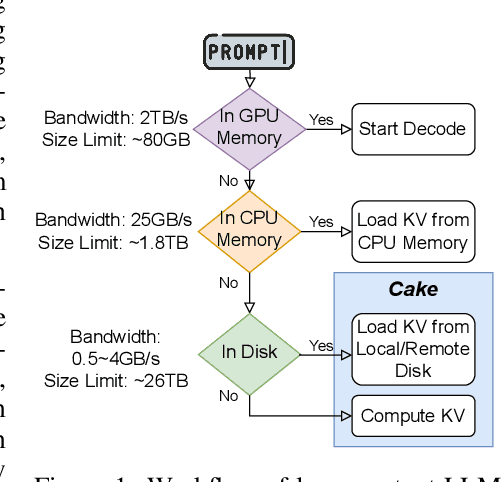


Recent advancements in Large Language Models (LLMs) have significantly increased context window sizes, enabling sophisticated applications but also introducing substantial computational overheads, particularly computing key-value (KV) cache in the prefill stage. Prefix caching has emerged to save GPU power in this scenario, which saves KV cache at disks and reuse them across multiple queries. However, traditional prefix caching mechanisms often suffer from substantial latency because the speed of loading KV cache from disks to GPU memory is bottlenecked by the throughput of I/O devices. To optimize the latency of long-context prefill, we propose Cake, a novel KV cache loader, which employs a bidirectional parallelized KV cache generation strategy. Upon receiving a prefill task, Cake simultaneously and dynamically loads saved KV cache from prefix cache locations and computes KV cache on local GPUs, maximizing the utilization of available computation and I/O bandwidth resources. Additionally, Cake automatically adapts to diverse system statuses without manual parameter. tuning. In experiments on various prompt datasets, GPUs, and I/O devices, Cake offers up to 68.1% Time To First Token (TTFT) reduction compare with compute-only method and 94.6% TTFT reduction compare with I/O-only method.
AutoSpec: Automated Generation of Neural Network Specifications
Sep 17, 2024
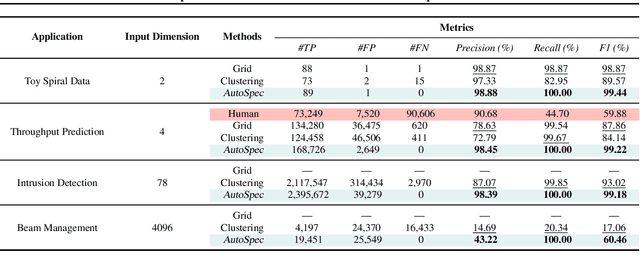

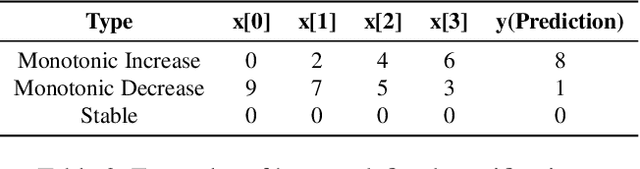
The increasing adoption of neural networks in learning-augmented systems highlights the importance of model safety and robustness, particularly in safety-critical domains. Despite progress in the formal verification of neural networks, current practices require users to manually define model specifications -- properties that dictate expected model behavior in various scenarios. This manual process, however, is prone to human error, limited in scope, and time-consuming. In this paper, we introduce AutoSpec, the first framework to automatically generate comprehensive and accurate specifications for neural networks in learning-augmented systems. We also propose the first set of metrics for assessing the accuracy and coverage of model specifications, establishing a benchmark for future comparisons. Our evaluation across four distinct applications shows that AutoSpec outperforms human-defined specifications as well as two baseline approaches introduced in this study.
Adaptive Skeleton Graph Decoding
Feb 19, 2024


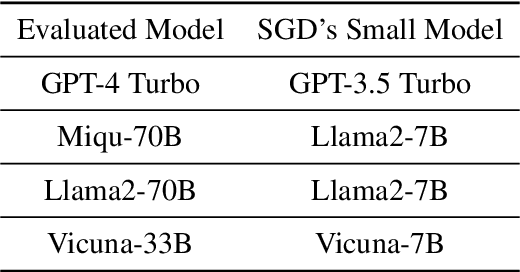
Large language models (LLMs) have seen significant adoption for natural language tasks, owing their success to massive numbers of model parameters (e.g., 70B+); however, LLM inference incurs significant computation and memory costs. Recent approaches propose parallel decoding strategies, such as Skeleton-of-Thought (SoT), to improve performance by breaking prompts down into sub-problems that can be decoded in parallel; however, they often suffer from reduced response quality. Our key insight is that we can request additional information, specifically dependencies and difficulty, when generating the sub-problems to improve both response quality and performance. In this paper, we propose Skeleton Graph Decoding (SGD), which uses dependencies exposed between sub-problems to support information forwarding between dependent sub-problems for improved quality while exposing parallelization opportunities for decoding independent sub-problems. Additionally, we leverage difficulty estimates for each sub-problem to select an appropriately-sized model, improving performance without significantly reducing quality. Compared to standard autoregressive generation and SoT, SGD achieves a 1.69x speedup while improving quality by up to 51%.
On Data Fabrication in Collaborative Vehicular Perception: Attacks and Countermeasures
Oct 03, 2023
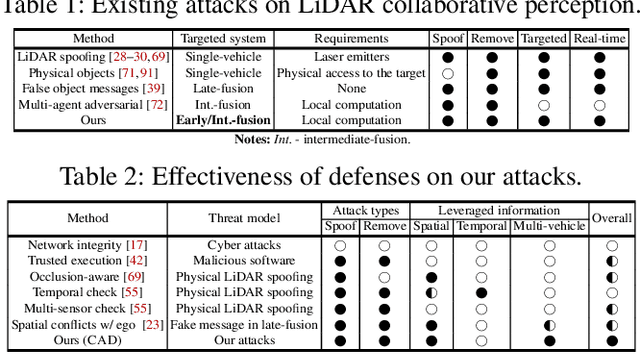
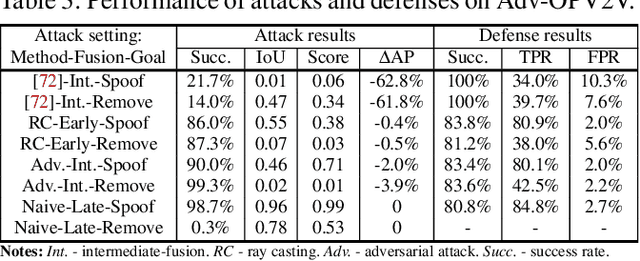
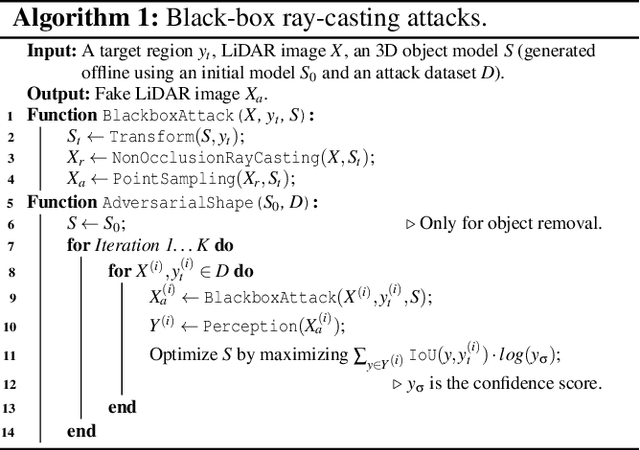
Collaborative perception, which greatly enhances the sensing capability of connected and autonomous vehicles (CAVs) by incorporating data from external resources, also brings forth potential security risks. CAVs' driving decisions rely on remote untrusted data, making them susceptible to attacks carried out by malicious participants in the collaborative perception system. However, security analysis and countermeasures for such threats are absent. To understand the impact of the vulnerability, we break the ground by proposing various real-time data fabrication attacks in which the attacker delivers crafted malicious data to victims in order to perturb their perception results, leading to hard brakes or increased collision risks. Our attacks demonstrate a high success rate of over 86% on high-fidelity simulated scenarios and are realizable in real-world experiments. To mitigate the vulnerability, we present a systematic anomaly detection approach that enables benign vehicles to jointly reveal malicious fabrication. It detects 91.5% of attacks with a false positive rate of 3% in simulated scenarios and significantly mitigates attack impacts in real-world scenarios.